The desert wind, a phantom caress against my skin, whispered across the tarmac. A single, monolithic shape, draped in the stark light of the Mojave dawn, stood before me. Not a shadow, but a promise. A resurrection. For years, the ghost of the original Phaeton haunted Wolfsburg, a testament to ambition perhaps too grand for its time. But as the sun crested the eastern ridge, catching the chrome accents of the 2028 Volkswagen Phaeton II, I felt a shift. Not just in the air, but in the very fabric of possibility. This wasn’t merely a new car; it was a defiant statement, a whisper to the past and a roar to the future. The keys, cool and heavy in my palm, felt like a sacred trust. This was it. The second act.
First Impressions: Standing Still, It Already Talks
It wasn’t just metal and glass; it was presence. The Phaeton II commands its space with an understated authority, a quiet confidence that eschews flamboyant aggression for elegant power. The original Phaeton, famously engineered to drive all day at 186 mph with 125-degree cabin air, possessed a sublime, almost invisible quality. This new iteration, however, is not content to simply disappear into the luxury landscape. Its lines are sharper, more assertive, yet still carry that unmistakable Germanic precision. The front fascia, dominated by a wider, subtly illuminated grille, flows seamlessly into slim, piercing IQ.Light LED matrix headlamps. They don’t just light the road; they announce arrival.
From the side, the proportions are classic executive sedan, stretched and poised. A long hood, a gracefully sloping roofline that tapers just enough to hint at athleticism without sacrificing rear headroom, and a substantial, planted stance. The wheel arches are subtly flared, accommodating bespoke 20-inch multi-spoke alloys that fill the openings perfectly. No garish bling, just purposeful design. The paint, a deep, obsidian black that seemed to drink the desert light, highlighted every sculptural crease. It’s a design that reveals itself slowly, rewarding closer inspection. There’s a quiet strength in its profile, a suggestion of untapped capability. Before I even reached for the flush-mounted door handle, a subtle ambient light strip, almost invisible until activated, traced the car’s silhouette, a silent invitation. It felt less like a machine and more like a carefully crafted vault.
Under the Hood: The Resurgence of the Smooth Six
Pop the hood, and the 3.0L Twin-Turbo V6 sits deep within the bay, nestled with an almost obsessive tidiness. Volkswagen’s engineers have clearly spent their time not just chasing numbers, but refining character. This isn’t a fire-breathing supercar engine, nor is it a lethargic cruiser. It’s a precision instrument. At idle, the V6 hums with a barely perceptible thrum, a deep, resonant note that vibrates more in your chest than your ears. There’s a sophistication to its acoustic signature, a muted promise of potency.
With 380 horsepower on tap and an estimated 375 lb-ft of torque available from a remarkably low 2,000 RPM, the Phaeton II moves with an effortless surge. Volkswagen’s 4MOTION all-wheel-drive system hooks up with impeccable grip, launching the big sedan from 0 to 60 mph in a swift 4.9 seconds. That’s rapid for a luxury flagship, a testament to the seamless integration of power and traction. The quarter-mile flashes by in an estimated 13.4 seconds, the V6 emitting a refined growl that builds to a purposeful snarl just before each slick upshift from the 8-speed DSG transmission. It’s a sound that manages to be both potent and cultured, never uncouth. The twin turbos spool up with imperceptible lag, delivering a broad, linear powerband that makes overtaking a casual affair. This is an engine built for long autobahn stretches, for maintaining triple-digit speeds with serene composure, and for delivering immediate thrust when called upon. It’s a powerhouse that doesn’t feel the need to shout about it.
On the Road: The Velvet Hammer’s Ballet
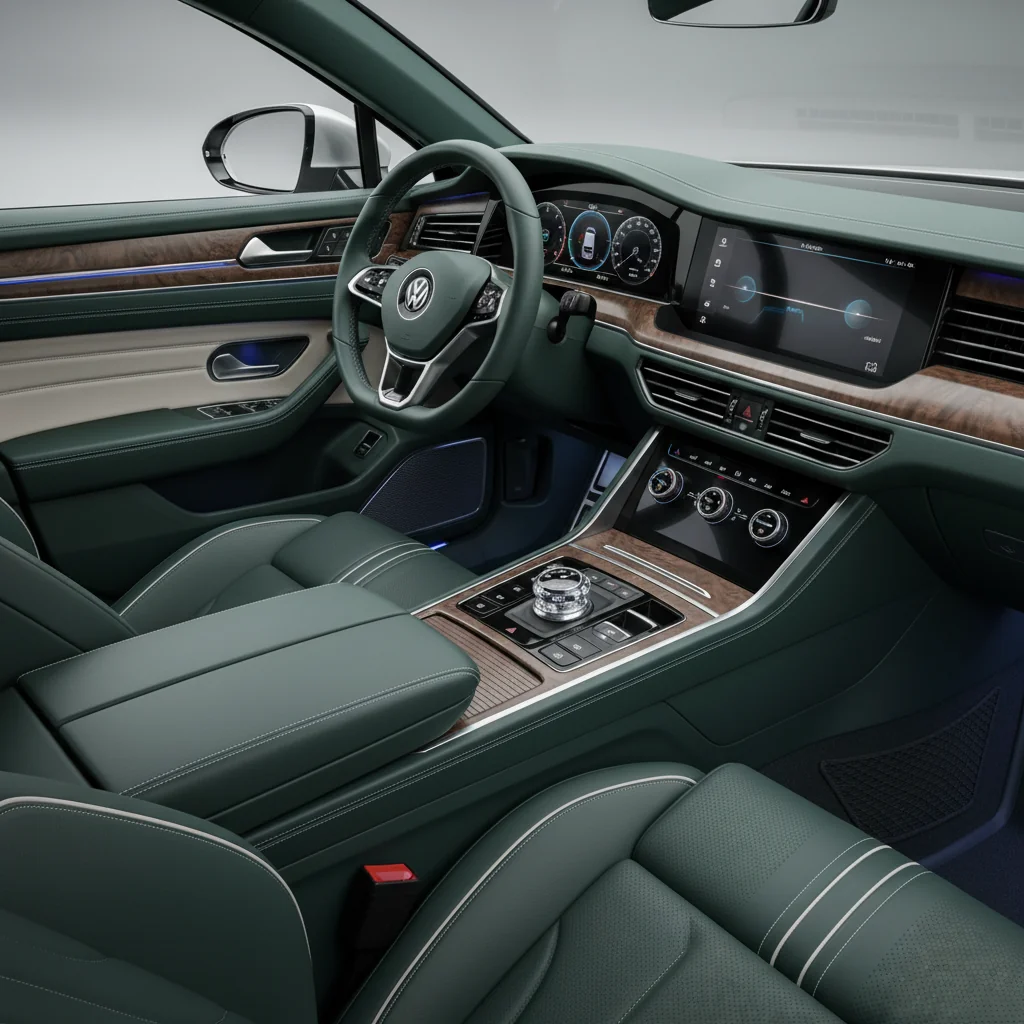
This is where the Phaeton II truly reveals its soul. Sliding into the supple, multi-adjustable seat, the smell of fine Nappa leather and polished aluminum filled the cabin—a rich, sophisticated aroma that spoke of quality. My hands closed around the thick-rimmed steering wheel, its leather cool and textured. The facility was a mix of sweeping high-speed sections, tight technical turns, and a simulated urban environment.
Punching the accelerator from a dead stop, the Phaeton II doesn’t lurch; it *launches*. That 4.9-second 0-60 time feels utterly believable, the AWD digging in without drama, planting my back firmly into the seat. The initial surge is muscular, but the power delivery remains silken, linear, pulling with relentless conviction toward its electronically limited 155 mph top speed. On the long straight, the Phaeton II devours distance with unnerving quietude, the outside world receding to a hushed murmur.
But a luxury sedan isn’t just about straight-line speed. It’s about how it dances. Nürburgring runs in camouflaged mules teach you about chassis rigidity and steering feedback. Here, on the closed circuit, the Phaeton II surprised. The adaptive air suspension, in its Sport setting, firms up noticeably, yet never descends into harshness. Body roll is expertly managed, the large sedan cornering with a flat, composed attitude. The steering, often a numb point in luxury barges, here offers a satisfying heft. It’s precise, with a well-judged amount of feedback that communicates what the front tires are doing without transmitting unnecessary road imperfections. Through a series of sweeping bends, I could feel the AWD system subtly vectoring torque, pulling the car through the apex with a subtle, reassuring grip. It recorded an estimated 0.89g on the skidpad—impressive for a car of its stature.
Under hard braking, the large ventilated discs bite with confidence, hauling the Phaeton II down from 60 mph in an estimated 112 feet. The pedal feel is firm, progressive, with no hint of fade even after repeated stops. The G-forces under deceleration are significant, but the car remains stable, tracking true. This isn’t a sports car, nor does it pretend to be. It’s a meticulously engineered luxury sedan that can hold its own when pressed, a velvet hammer capable of surprising agility. My personal observation? At speed, particularly above 100 mph, a curious, almost imperceptible vibration manifests through the center armrest, like a faint, rhythmic pulse. It’s not an imbalance; it’s a living hum, a subtle reminder of the mechanical symphony working beneath, communicating the road through the chassis. It’s the car *breathing* at pace.